







Norfolk's drivers could face "restraints" on filling up with diesel this winter if fuel is rationed due to severe supply shortages.
Speed restrictions to reduce fuel consumption could also be imposed under the government's National Emergency Plan for Fuel.
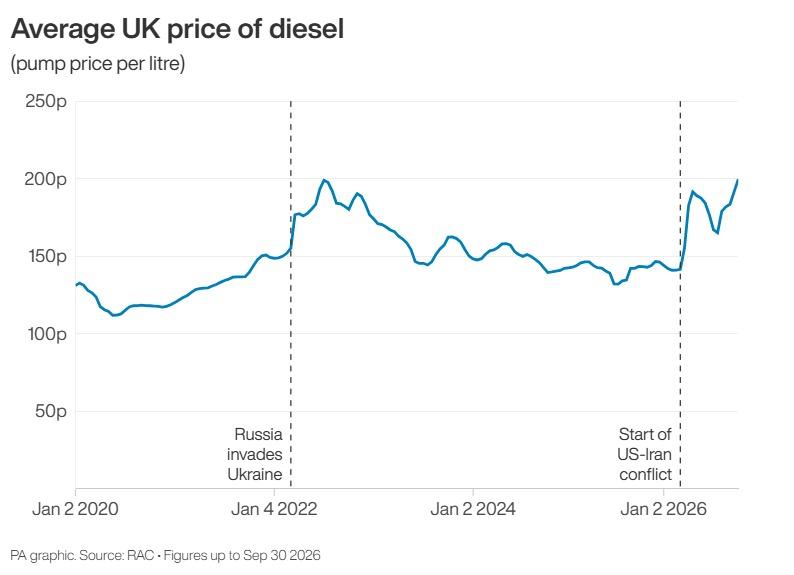
It comes as the price of diesel hit a record high in the UK, topping £2 a litre at some forecourts.
The average price at the pump stands at 199.35p per litre, according to the RAC, surpassing the previous record set in 2022 after Russia's full-scale invasion of Ukraine.

People in rural Norfolk – who rely on their vehicles to get around the county – could be disproportionately affected by the emergency fuel-saving measures compared to motorists in other parts of the country.
Prime minister Andy Burnham said the government is considering "every possible measure" to cut fuel costs, with the RAC warning that filling an average family car now costs nearly £110 – representing a £31 increase since the start of the US-Iran war in February.
This week, former BP executive Nick Butler warned "restraints" on the use of diesel could be put in place for drivers this winter.
He said the government has "a duty to protect key sectors", such as food producers and the NHS, over ordinary motorists.
When asked if it could lead to fuel rationing, he said: "Yes. If there’s a shortage, and if you have to protect key sectors, then there's less for everyone else.
"I think it would be unfair to do it on just rationing by price, so that only those who can afford the higher prices get it."

It is understood that the government is not currently considering imposing fuel rationing or speed restriction measures – but the National Emergency Plan for Fuel remains in place as an active contingency for responding to major fuel supply disruptions.
The cost of diesel has now risen by 59p a litre, or just under 40pc, since the outbreak of the war in the Middle East in February.
Over the past seven months, the conflict - and Iran's blockade of the Strait of Hormuz - have severely disrupted the production and transportation of wholesale oil, causing the cost of fuels made from oil to surge.

The diesel crisis is expected to worsen after the UK’s largest refinery shut down production for up to 10 weeks.
Fawley refinery, in Hampshire, will be closed until November for planned maintenance.
The site, which opened in 1951 and is now operated by ExxonMobil, produces nearly one-fifth of the fuel used on UK roads.
The UK had 18 refineries in the 1980s, but most have closed, leaving just four.
A possible ban on US exports of diesel, said to be under consideration from Donald Trump, has only added to concerns about soaring prices.
A Department for Energy Security and Net Zero (DESNZ), which is responsible for the UK's fuel emergency planning, said: "We have a diverse and resilient supply.
"We continue to engage with our international partners and the UK fuel industry."

The Road Haulage Association (RHA) represents HGV, coach and van operators.
Richard Smith, managing director, said the future for many haulage, coach and van operators in Norfolk is looking "increasingly uncertain" as spiralling fuel costs hit margins.
Ahead of next month's budget, the trade association has called for the chancellor John Healey to announce a fuel rebate for essential users to help control the costs of moving people and goods and relieve inflationary pressures.
“We also urge the chancellor to scrap plans to increase fuel duty and to not link it to the Retail Price Index in the new year," Mr Smith added.

Sanders Coaches, based in Holt, in north Norfolk, said the current record-high diesel prices could add more than half a million pounds to the firm’s costs over 12 months, compared to prices before the start of the Iran war in February.
Charles Sanders, managing director, said fuel prices are now "the number one concern for bus operators in Norfolk".

"At today’s price compared to February 2026, our costs would be over £500,000 more in a full 12-month period," he added.
"Services are likely to be at risk of cancellation if costs cannot be passed on somewhere, as they are now becoming unviable."
Most coaches and 70pc of local buses run on diesel.
As of June this year, there were around 10 million diesel cars on UK roads, while 96pc of light commercial vans and almost 99pc of HGVs run on the fuel.
Most tractors and around a quarter of the nation’s trains are diesel-powered.
Patrick Crehan is fuel procurement manager at Norfolk-based agricultural purchasing group AF, which sources around 90m litres of liquid fuel for its members per year.
He said farmers already struggling with high input costs have now been hit by steep rises to subsidised red diesel, which is sold at a reduced rate of fuel duty for permitted uses such as agriculture.
“We have not seen prices this high for a very, very long time,” he said. “Red diesel prices have been floating around £1.10 per litre, which is about 40pc higher than last year. Anything above 80p is usually deemed as expensive.
“As a whole, input costs on farms at the moment are very high, and fuel and fertiliser in particular have been high for most of 2026, so this is another added cost that no-one would have budgeted for. Inevitably, it is having an impact.
“Going back to [the start of] the Russia-Ukraine war, we saw similar prices, but the difference then was that volatility petered out relatively quickly. But now it has been such a long period of time from March until now to see prices this high, and we have not really seen a let-up.”


Share